|
|
PUSHING FOR A BETTER FUTURE: VIEWS FROM THE 2022 TRANSFORMING EDUCATION SUMMIT |
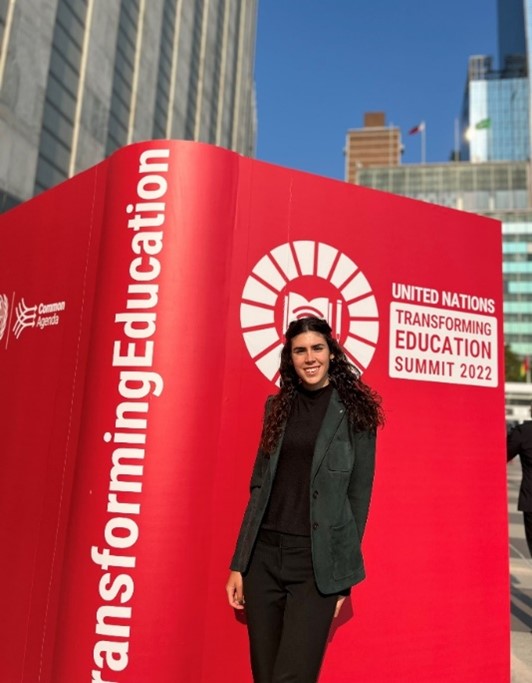
New York, 16 September 2022 — As a member of the UNODC YouthLED Integrity Advisory Board, I had the opportunity to participate in the Transforming Education Summit held at the United Nations Headquarters in New York in mid-September 2022. The Summit, aimed at mobilizing action, solidarity, and solutions to transform education, was convened in response to global ongoing crises that have heavily impacted the education sector.
Education is a human right and the cornerstone for sustainable development. The Summit represented an ideal opportunity for me to reflect on the impacts of corruption on the education sector and on how education can serve as a means to teach youth about the importance of transparency, accountability, integrity, and a culture of zero-tolerance toward corruption. Quality education should include ethics, integrity, and anti-corruption education.
Over the course of three days, I advocated for the inclusion of anti-corruption education and measures as essential elements for transforming education. In particular, on the first day, I had the pleasure of serving as rapporteur for a dialogue session with Secretary-General António Guterres. The session was an interactive dialogue between the Secretary-General and youth leaders on the role of young people in transforming education. As the representative for the SDG 4 high-level steering committee, Kenisha Arora, highlighted during this session, “we need a shift in the movement and a rethink of solutions (…) it's not only about having us at the table. It is also about making decisions (…) we have to join hands in solidarity (…) when working with our peers is that education is transformed.”
Following this, I was chosen for the role of facilitator during the Big Education Conversation launch. The event invited participants to share their thoughts as to why education is important to them and what we, as youth, can do to promote it. Despite our different backgrounds, during our conversation, similar topics came up. No matter where we were from, we all considered education settings to be more than formal classrooms and lecture halls. Education also occurs in informal settings, such as the sports field. For us, quality education includes teaching values and principles that will guide students in their studies, work, and life. We agreed that we need to look at the past and learn from it. Only then will we be able to transform education successfully. Lastly, we also discussed the importance of anti-corruption measures and education. Ethics, integrity, and transparency are values that need to be learned from a young age.
In my time in New York, I had the opportunity to meet with the Representative of the UNODC New York Liaison Office, Delphine Schantz. During our meeting, we discussed the importance of promoting youth engagement in preventing and combating corruption and the role that we, the youth, have in pushing anti-corruption to the top of the political agenda as well as actively contributing to the implementation of existing anti-corruption measures.
On the third day of the Summit, I met Jutta Urpilainen, Commissioner for International Partnerships of the European Commission. We agreed that it is imperative, when negotiating new financing for education, to include anti-corruption measures aimed at reducing the misuse of public funds allocated to education.
One important achievement of the Summit, in my view, was that it brought together youth, civil society, the private sector, and high-level representatives from governments and international organizations. To achieve change, we need all these actors to join forces and work together towards shared goals.
Having the opportunity to participate in the Summit was a life-changing experience for me. A lot of strong messages were delivered during the three days, a lot of commitments were made.
One big highlight was seeing so many young activists pushing for the same goal: a better future. This is our planet, and this is our society and there is no plan B – countering and combating corruption through education is the number one strategy to guarantee next generations a better future. As the Secretary-General stated, “let’s make sure today’s learners and future generations can access the education they need, to create a more sustainable, inclusive, just and peaceful world for all.”
Now that the Summit is over, it is time to act. Commitment without actions will not get us where we need to be.
The Youth Declaration demands the establishment of “robust and democratic measures and procedures for transparent, accountable, and effective implementation” of the Summit’s recommendations and to “hold accountable the actions of decision-makers”. To achieve this, we imminently need young people and children to learn what transparency and accountability mean. UNODC’s Global Resource for Anti-Corruption Education and Youth Empowerment, the GRACE Initiative, is in the perfect position to advance anti-corruption education and promote youth empowerment. On behalf of the UNODC YouthLED Integrity Advisory Board, a group of talented and committed young people dedicated to support GRACE in shaping the global conversations on preventing corruption through education and meaningful youth engagement, I pledge to continue using our platform to promote youth empowerment, integrity, ethics, and anti-corruption to transform education both at home and globally.