



Written by Parnneh Mallobe, Rafael Leite and Tsenguunbileg Naranpurev
On 3 May 2023, UNODC's YouthLED Integrity Advisory Board hosted the fifth episode of the thought-provoking online dialogue series “YouthLED Anti-Corruption TALKS”, titled “Media and Corruption, in celebration of the World Press Freedom Day. This stimulating event brought together a comprehensive array of speakers, for instance young leaders, journalists, and media experts from various backgrounds and regions. By assembling such a diverse group, the event fostered rich discussions that shed light on the multifaceted challenges faced by the media in combating corruption.
The event commenced with opening remarks from renowned Ghanaian journalist Anas Aremeyaw Anas and Liberian investigative journalist Alline Louise Dunbar. Anas, known for his groundbreaking undercover work and innovative methods, emphasized the numerous challenges African journalists face, particularly when tackling corruption. He highlighted the need for young journalists to build resilience against persecution and legal issues and urged them to forge alliances and collaborate with organizations such as the CENOZO (Cell Norbert Zongo for Investigative Journalism in West Africa).
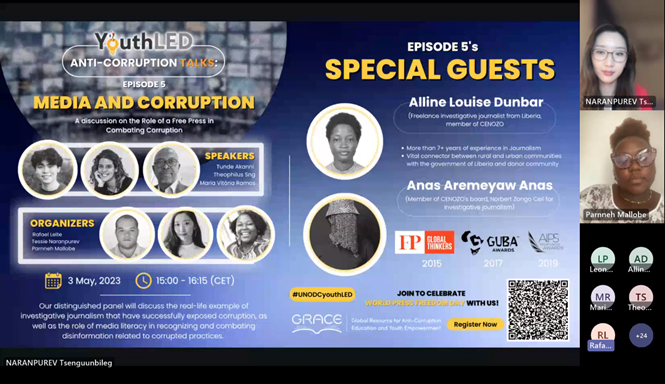
Anas' insights provided a fitting complement to Dunbar's remarks. Dunbar, a freelance investigative journalist from Liberia, shared her experiences of overcoming various challenges during her investigations. Despite feeling demotivated due to the lack of support in her country in 2021, Dunbar eventually returned to investigative journalism with a renewed sense of patience, persuasion, and prayerfulness. She underscored the importance of exercising caution, adhering to rules, and seeking help when necessary.
The diverse line-up of speakers included Professor Tunde Akanni, Head of the Journalism Department at Lagos State University, who eloquently discussed the importance of press freedom in combating corruption and ensuring government accountability. He underscored the media's role in informing, educating, and undertaking surveillance in society, while urging civil society organizations to prioritize anti-corruption efforts, engage in coalition-building, and establish international networks.
Theophilus Sng, a digital strategist and filmmaker, shed light on the role of social media in the fight against corruption. He presented two case studies demonstrating the power of social media and memes in raising awareness, mobilizing collective action, and holding institutions accountable. Sng emphasized the importance of media literacy and critical thinking for effectively utilizing social media.
Maria Vitória Ramos, a Brazilian journalist and co-founder of Fiquem Sabendo, highlighted the significance of freedom of access to information and a free press in combating corruption. She presented various case studies, showcasing how her organization leveraged freedom of access to information laws to expose irregularities and enforce government accountability. Maria stressed the value of collaboration, education, and transparency in the fight against corruption.
The YouthLed TALKS event not only emphasized the vital role of press freedom in promoting transparency and accountability but also inspired young people to actively participate in anti-corruption efforts through media engagement. By engaging in this dialogue, young leaders acquired the knowledge and tools needed to make a meaningful impact in the global effort to eradicate corruption.
It is important that multilateral partnerships are established in order to empower Youth to understand the complexities of corruption, especially in relation to media freedom. This complex interplay between youth, journalism, press freedom, and the fight against corruption, is indeed a reminder that progress in combating corruption demands not only individual resilience and determination but also a collective effort that transcends geographical and cultural boundaries. By harnessing the power of diverse perspectives and experiences, we can develop more nuanced and effective strategies to prevent and counter corruption.
Moreover, we must work together to respond to the need for an environment that fosters freedom of expression, critical thinking, and access to information. As young journalists navigate the treacherous waters of investigative reporting and expose corruption, they must be equipped with the necessary tools, resources, and support networks to weather the challenges that lie ahead. In doing so, they will be empowered to catalyze change, hold power to account, and reshape societal norms.
In conclusion, in the year of the 20th anniversary of the United Nations Convention Against Corruption (UNCAC), young people are no longer mere spectators, nor beneficiaries. Young people are not the future generations of laders, but rather the current generation of integrity champions.
We are ready to step-up and be co-leading partners, a resource that today is very much needed to contribute to long-lasting and imapctful global anti-corruption efforts.
Finally, it is through such thoughtful introspection and the forging of robust partnerships, grounded on the vital role of youth for tangible behavioral change, that we can pave the way for a more just, transparent, and accountable world.


