

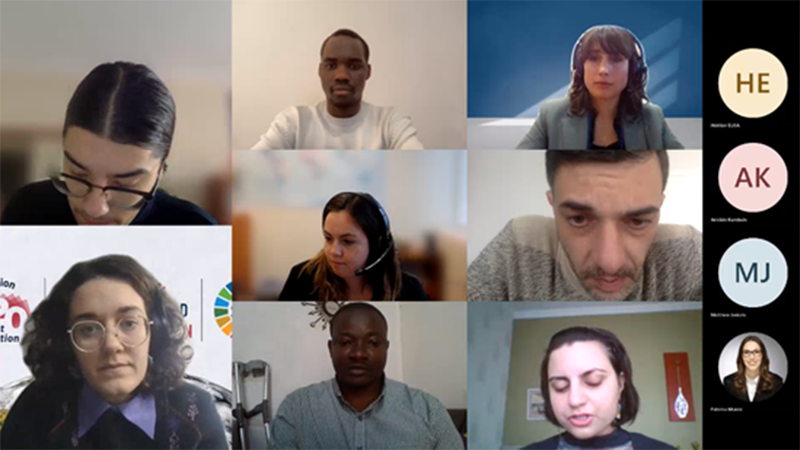
The 1st episode of YouthLED TALKS series of webinars, named "Inclusion and leadership of youth with disabilities to contribute to the achievement of SDG16", took place virtually, on 9 December 2022, on the margins of the International Day of the Rights of Persons with Disabilities celebrated on 3 December and International Anti-Corruption Day, celebrated on 9 December.
The webinar was organized by Esma Gumberidze and Sylvain Obedi Katindi, respectively from Georgia and the Democratic Republic of Congo.
In view of the lack of literature on the theme of interlinkages between corruption and disability rights, the discussions held during this webinar and the thought-provoking results it has generated in the participants, all represent evidence of the great importance of this theme and the need for further attention from multiple stakeholders, spearheaded by United Nations Organizations such as UNODC.
What is indeed important to raise awareness on and further research, is the fact that persons with disabilities are likely to feel less empowered than other demographics to stand up against corruption and take action against it in varied forms. This could be due to the fact that unfortunately people with disabilities have less choices, less information and less resources and opportunities to voice their concerns and are instead often depending on others which means that even more resilience and drive to fight against corruption is needed in these circumstances.
In addition, disability is still often stigmatized and this is likely to have a destabilizing effect on corruption. Persons with disabilities and their assistants are often indeed perceived as “better people”, people that because of their circumstances they are carriers of higher moral standings. Thus it is often unimaginable for the outside public that persons with disabilities, their family members and professionals working with and for them, can actually be moved by greed and other factors that are conducive and enabler of corrupt behaviour.
Persons with disabilities, unlike commonly spread misconceptions, may become both the victims and beneficiaries/perpetrators of corruption. They can for instance both accept and give bribes. Although it is necessary that convicted persons with disabilities shall not be disproportionately negatively affected in a prison system (for instance by being incarcerated in prisons that are not fit to welcome people with disabilities, both in terms of infrastructure and in terms of expert professional support provided by the prison administrators), it must be globally recognized and upheld that nobody is immune from responsibility and everyone must respect the rule of law, including people with disabilities.
The UN Convention on the Rights of Persons with Disabilities (UNCRPD) adopted in 2006 tells us that persons with disabilities are hindered in their participation in society by the lack of accessible environment, support services, assistive devices and a lot of stigma, rather than by their individual characteristics. According to a human rights-based approach to disability, which the convention adopts, persons with disabilities are persons first, just like everyone else, and in value of this they too carry positive and negative characteristics and aspirations.
According to research conducted by Transparency International, people with disabilities are exposed to abuse by those that provide care, for instance in cases of embezzlement of funds intended to benefit persons with disabilities and cases of extortion happened in the process of acquiring a disability certificate. Furthermore, they are often forced to bribe the nursing staff in closed institutions to get their entitlements while under constant control lacking the ability to “blow the whistle” to report such mis-happenings. These instances prove clearly that persons with disabilities can be severely and disproportionately affected by corruption. This impact of corruption on people with disabilities is caused, enabled and exacerbated by discrimination against persons with disabilities.
The Committee on the Rights of Persons with Disabilities (CRPD), which overseas the implementation of the UN Convention on the Rights of Persons with Disabilities, has observed that persons with intellectual disabilities, persons with psychosocial disabilities, children, people of senior age and women with disabilities are particularly “exposed to systematic and structural discrimination”. Discrimination can result in greater exposure to corruption: groups exposed to discrimination indeed tend to suffer from an above-average risk of falling victim to corruption, in which corrupt actors intentionally target them for exploitation. Both corruption and discrimination create and perpetuate structural inequalities and are interconnected and both design circumstances in which people with disabilities are likely to be victimized and incapacitated from receiving needed services and resources necessary for their well-being.
One even more specific case is that of children with disabilities because parents or guardians can be likelier than people with disabilities that have reached adult age, to not report corruption or to engage in corrupted behaviours in order to provide care to their children.
Furthermore, civil society organizations run by family members of persons with disabilities are often confused with organizations of persons with disabilities, while in reality they constitute yet another interest group. The decisions and activities undertaken by such organizations often ae shared with the wider disability rights community only after being made or planned. This lack of transparency and accountability provides good soil for potential corruption.
All the above described issues can be solved through enhanced agency of persons with disabilities and their meaningful inclusion in decision-making processes. If we believe that people with disabilities are people just like everyone else, then we need to accept that they know their own needs better than others. Consecutively persons with disabilities, for example, must be the ones who voice their needs and concerns, they must be the ones who are consulted when treatment and services are to be disbursed, they must be the ones who employ, supervise and dismiss their own assistants, etc.
This is why disability inclusion is an essential condition to upholding human rights, sustainable development, and peace and security. We must uphold and safeguard the “Leave no one behind” value and work together in order to promote the 2030 Agenda with and for people with disabilities, because only in this way we can recognize that protecting and strengthening the rights of persons with disabilities is gateway for more just world and it is an investment in a better common future.


