|
|
EMPOWERING EDUCATORS TO CHANGE YOUTH’S MINDSETS TO PREVENT AND COUNTER CORRUPTION |
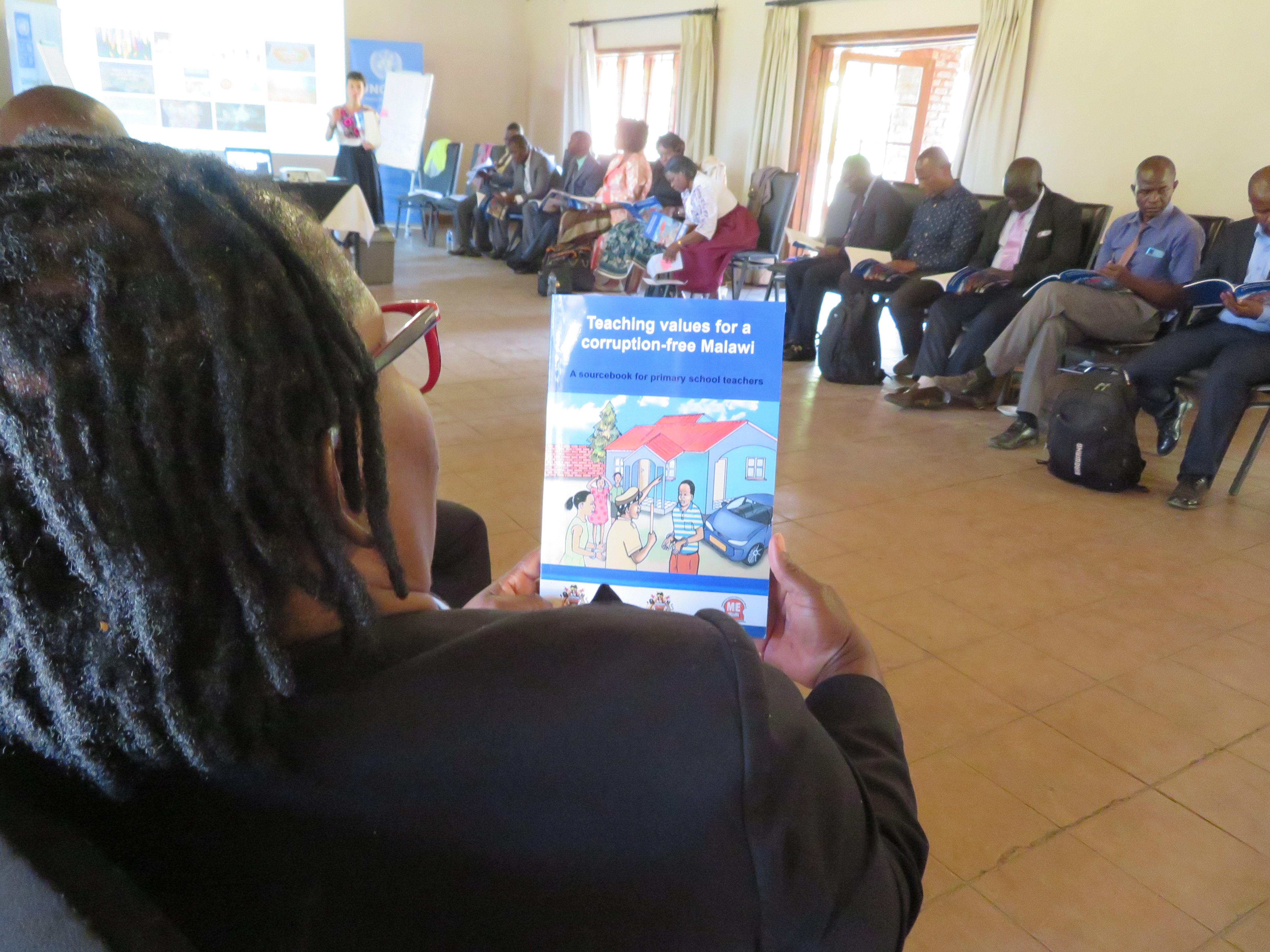
15-17 August 2023 – Corruption is a complex phenomenon, often involving several actors and power relationships, disempowering the most vulnerable, and triggering feelings of unfairness and distrust in public institutions.
To teach our youngsters how to prevent and counter corruption when they see it and how to contribute themselves to developing a culture of integrity, we need to start by encouraging more complex thought processes from primary school onwards.
Active learning is a classroom approach that focuses on how students learn, not just what they learn. Opportunities provided by teachers, such as enquiry-led tasks and open-ended questions, challenge the students and supports them to build knowledge and their own understanding.
Active-learning techniques and learner-centred approaches were chosen as the foundation of the teaching methodology of the Malawi primary sourcebook entitled “Teaching Values for a Corruption-Free Malawi”. The book is divided into seven units recognising and promoting the understanding of corruption and its consequences, uMunthu, altruism, honesty, hard work, and integrity. It was published by the Malawi Anti-Corruption Bureau (ACB), the Malawi Ministry of Education (MoE) and the Malawi Institute of Education (MIE) with the financial and technical support of UNDP and UNODC.

Thanks to the leadership of the national partners and the collaboration with UNDP Malawi, from 15 to 17 August 2023, the GRACE Initiative successfully delivered the first teacher training on these values and methodology in Lilongwe.
The first day of the training was dedicated to developing buy-in from the various participants, all current and former teachers, on the need to teach ethics and integrity at the primary education level. One of the teachers, in response to a group of sceptics on the effectiveness of this approach said, "when a thing is difficult, it is not impossible, mindset change takes time!" and another teacher echoed "teachers are the first ones that need to have uMunthu".
By the end of the training all the teachers were convinced of the effectiveness of the approach of teaching values to fight corruption and ready to advocate for its inclusion as a mandatory subject in the national curriculum. One of the participants said, "it is a very important skill we are discussing here, so if we leave it outside the curriculum, we are making a mistake".
The Malawi Anti-Corruption Bureau, the Malawi Ministry of Education and the Malawi Institute of Education stand ready to continue delivering more teacher trainings using this methodology with UNODC and UNDP. As the country is approaching a national curriculum review, this book and the teacher trainings will serve as a foundation for the inclusion of such topics.


